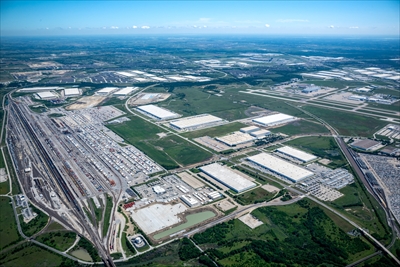
Hillwood, developer of the 27,000-acre AllianceTexas development in Fort Worth, continues to move forward with its effort to create the inland port of the future.
Hillwood, BNSF Railway and the City of Fort Worth established the Alliance Logistics District following a Fort Worth City Council vote on Nov. 11 enabling its creation. The ordinance passed by the council eliminated certain requirements and fees for overweight vehicles operating on city streets within the established district and adopted a resolution supporting the use of hostler trucks and autonomous vehicle technology.
With the new district, Hillwood aims to make the movement of goods from warehouses to the BNSF Alliance intermodal facility easier, said Nick Konen, vice president of strategic development.
“We’re trying to make that movement as efficient as possible, and to allow for any type of movement that could theoretically come off of the rail,” he said
The creation of the district, which spans 1,400 acres, allows the use of self-driving vehicles along roadways in the freight corridor. It also allows the use of private hostler vehicles without a commercial driver’s license to shuttle freight between the BNSF facility and warehouses. Finally, it allows trucks to carry loads of more than 80,000 pounds across the district’s roadways without the need for special permits.
Konen said BNSF’s facility plays an important role in moving goods in the region. Outside of seaports, the types of zones like the one recently created don’t exist at inland hubs, he said.
The Alliance facility is one of BNSF’s largest by volume and performs more than 1 million lifts a year.
Konen said the zone is the “cornerstone” of Alliance’s “smart port” strategy. Alliance is building a $262 million “smart port” to enhance the movement of cargo via new infrastructure, including a “smart connected bridge” from the BNSF Intermodal Facility to State Highway 170, a new 32-acre integrated intermodal depot with BNSF and the addition of 5G communication network capacity. Hillwood is also building a $20 million private bridge over FM 156 to link its industrial space to the BNSF Alliance intermodal facility.
“This is us being smart with how we structure the port and how we structure operations, or enhance those operations,” Konen said. “And we’re setting it up for an eye toward autonomy, which we know is coming.”
John Gabriel, group vice president of consumer products at Fort Worth-based BNSF, said the district, along with the private bridge, will help the railroad operate more efficiently by reducing transit time and travel distances for delivery of goods.
“It makes more traffic rail competitive, meaning rail can compete with … truck,” Gabriel said. “But it also allows those customers, those shippers that are using this mode to save the cost, to increase their capacity in their supply chain and ultimately reduce the carbon emissions.”
The BNSF facility at Alliance is believed to be the largest rail intermodal facility in North America, sitting on about 500 acres.
The area within the Alliance Logistics District could eventually see 14.9 million square feet of industrial warehouses, according to Hillwood. Current tenants in the area include Southwire, Walmart and the future Wistron facility. The inland port serves as the port of entry to the southwestern U.S. and connects to other ports including Los Angeles, Long Beach and Houston. AllianceTexas accounted for $834.6 million in trade in 2024, according to a recent study by the Texas Comptroller.
More construction related to AllianceTexas’ smart port is one the way, Michael Morris, director of transportation at the North Central Texas Council of Governments, said in early October. That work, which is in final design, includes dedicated lanes for trucks from SH 170 onto Intermodal Parkway. Part of the smart port effort is also creating a database to keep track of where containers are to coordinate efficient pick up off of a train.


