Matt Byrd wants aviation companies to fulfill the promise of “The Jetsons” — the 1960s space-age, animated TV show that brought the concept of flying cars into American living rooms.
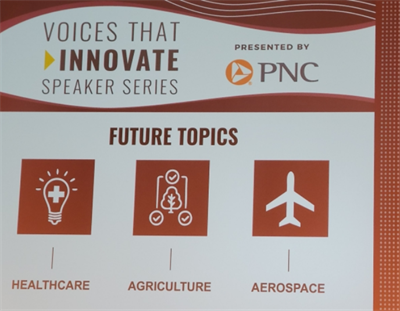
As advanced technology grows rapidly, the futuristic transformation of transportation modes is bringing science fiction closer to science fact, participants at a Texas A&M-Fort Worth aviation panel said Aug. 25 at the Kimbell Art Museum.
“This is an incredibly exciting time to be alive,” said Byrd, president and CEO of Hillwood Aviation. “I think we’re at an inflection point in aviation.”
Byrd cited American innovation in aviation since Orville and Wilbur Wright had their first controlled flight in December 1903 at Kitty Hawk, North Carolina. By the 1950s, he said, jet-powered flight enabled transatlantic flights from the United States to Europe.
“Now we’re entering automated, electric or hybrid-electric aviation with drone deliveries and people being able to fly,” Byrd said. “It’s incredibly exciting. And it’s just been a mere 123 years to get to this point. What is the future going to hold?”
Excellence in innovation is propelling technology forward, prompting governments worldwide to adopt new transportation modes, including autonomous and piloted vertical-lift aircraft.
Panelists said Fort Worth will benefit from the emerging technology. Educational institutions such as Texas A&M-Fort Worth and Tarrant County College have launched aviation-related workforce programs to keep up with the demand for jobs to service and maintain next-generation aircraft.
Cowtown’s flight path
North Texas became an aviation hub after Fort Worth newspaper publisher Amon G. Carter Sr. offered flight demonstrations eight years after the Wright brothers’ achievement.
French aviator Roland G. Garros, flying a Bleriot XI monoplane, is recorded as the first person to perform a powered flight from Fort Worth on Jan. 11, 1911. Thousands saw the flight at a racetrack known as Fort Worth Driving Park — now the site of Montgomery Plaza off West 7th and Carroll streets. First Flight Park, at 2700 Mercedes Ave. commemorates the historic event and features a replica of Garros’ plane.
Over the decades, Fort Worth hosted three training fields for World War I pilots, operated as a port for dirigibles or airships in the 1920s, and was the site of a B-24 and B-32 airplane bomber factory during World War II.
That facility, known as Air Force Plant 4, now assembles F-35 aircraft produced by Fort Worth-based Lockheed Martin Aeronautics Co.
In 2024, North Texas became the first area approved by the Federal Aviation Administration for commercial drone deliveries with Wing Aviation and Zipline as the companies authorized with carrying out the task.
“North Texas has really been involved in the aviation world for quite some time,” said Dave Martin, a project manager for the Texas A&M system’s Center of Advanced Aviation Technologies.
Ivett Leyva, associate dean for research at Texas A&M-Fort Worth, said North Texas is now known for aviation innovation and leadership.
“Matt talked about the spirit and leadership our country is known for,” she said. “I think that you can breathe, smell, hear (that) in North Texas. North Texas has that going, plus it has industry.”
Air taxis
Although flying cars aren’t yet on the horizon, electric and hybrid-electric vertical-lift aircraft — often called air taxis — are coming to North Texas, possibly as soon as 2027, Byrd said.
Public acceptance of such aircraft is crucial to their success, panelists said.
“Air taxis are a lot closer than we believe,” said moderator Albert Bejarano, associate director for the Center for Advanced Aviation Technologies.
The initial plan is to have the aircraft fly above highways, Byrd said, with safety being of paramount concern.
“Vehicles won’t be certified until they are safe,” Byrd said.
The noise generated by electric and hybrid aircraft is relatively low — about 45 decibels, which Byrd likened to “a soothing sound like wind blowing through the trees.”
Costs for air taxis will be based on a $3 per mile rate. North Texas passengers will soon be able to use the vertical-lift technology to reach Dallas Fort Worth International Airport at a cost of about $100 to “avoid all the traffic,” he said.
Byrd said he expects younger generations to use the aircraft without hesitation.
“The future is here,” he said. “It’s very, very exciting.”
The need for aviation-related mechanics, air traffic controllers and other skilled workers will help North Texas develop its workforce. Leyva referenced a significant shortage of air traffic controllers.
Developing a workforce of skilled workers will help North Texas “secure our place in the history of this inflection point,” Byrd said.
To maintain electric aircraft, the country will need to mine for rare earth minerals in new areas, he added.


